Dry Cleaning versus Laundry Washing

What is Dry Cleaning?

Dry cleaning, as the name suggests, is simply cleaning the fabrics without using a water. However, dry cleaning is not 100% liquid-free. Dry cleaning services use perchloroethylene, also called perc, a liquid chemical that removes dirt and stains on clothing. Dry cleaning, I perfect for materials and clothing that are thick or too heavy to load into washing machines. Dry cleaning is therefore perfect for carpets, rugs, curtains and suits. Dry cleaning has it downsides (such as cost and convenience), but it also has many advantages. Some advantages are:

  • Dry cleaning protects delicate items
  • Dry cleaning removes grease and oil stains effectively.
  • Dry cleaning limits shrinkage
  • Dry cleaning does crumple fabric
  • Dry cleaning will almost certainly increase the life span of the garments
  • Dry cleaning ensures that discolouration is reduced


What is Laundry Washing?

Laundry washing involves using water, detergents, and fabric softeners to clean and soften fabric. Traditionally laundry was done by hand (and is sometimes still done in this way) but is these days usually done by using a washing machine. Though laundry washing has its drawbacks (uch a damage to fabric over time, se limitations and the length it takes to dry), there are many advantages to laundry washing. These include:


In bulk and in the long run, laundry is more cost effective than dry cleaning

Laundry washing ensures that the whatever is being washed is cleaned at a very deep level

Laundry washed garments, clothes and fabrics have a new and fresh odour and particular scents can be chosen according to personal preference

It is skin-friendly and it does not harm the environment

Laundry washing can be done in the convenience of one’s own home, at whatever time is convenient


Condrou Manufacturing

Condrou Manufacturing (Pty) Ltd in South Africa specialises in solutions for all dry cleaning, laundry and hospitality consumables ranging from branded suit bags, hangers, refuse and laundry bags, clothing rails, dry cleaning and laundry machines as well as finishing equipment and other hospitality products. We also offer laundry marking systems and tags, pens and stationery.

Fresh and ready from the get go

When it comes to clothing, everyone strives for the best washing process to ensure that we can carry on with our everyday lives feeling fresh and new every time. One way of doing this is through the use of tip top machinery and cleaning products. At the hospitality consumables suppliers to South Africa, one can find all the products that would be needed to ensure that each item of clothing always comes out the cupboards clean and ready for use.

Products for all uses

To get all the hospitality products all at once, may be a mission at times as we may not know what exactly is needed for particular sets of clothing. However, that is not an issue anymore, anyone can find all the products and machinery needed for any sets of clothing. With online shopping you can find exactly what you need and may discover more. There is a large variety of products that one can choose from that can be used at home or for any hotel needs. Such products include laundry bags, hanger stands and clothing rails. There is also a variety of cleaning products such as bleachers, boosters, detergents, fabric softeners and much more.

Machinery

When it comes to laundry services, speed is one of the most important factors. As the large amount of clothing and linen that floods in on a daily basis can be immense. Having machinery that can keep up with the load and is what one needs to keep up with the inflow. Luckily, that’s just one phone call away. There is a multitude of machinery that can help staff with loads which includes steam irons, boilers, presses, ironing boards and plenty more.

Find out more

If Condrou Manufacturing has what you need or if you would like to find out more about some of the other products that are available here. Contact them at their Tel: 011 452 6573 | 011 452 6592, their phone number: 081 359 3015 or simply email them at info@condrou.com.


What You Need to Open a Laundromat or Dry Cleaning Business

Running your own laundromat or dry-cleaning service comes with many advantages and challenges, just like any business. However there are a few specialised requirements in these industries, particularly where the investment into machinery is concerned, and the scale at which this machinery needs to be purchased.

So if you were thinking of opening your own, knowing what types of machinery you will need to invest in will help you prepare more thoroughly, and enable you to run a business that moves from strength to strength. So let’s take a look at the laundry and dry cleaning machines you will need.

Spotting and Finishing Tables

Both spotting and finishing tables will allow your business to provide the best laundry services and will also allow you to work with greater quantities of laundry at once.

Spotting tables are used to treat stains, whether they have been created during the manufacturing process or by accident. Regular washing equipment isn’t always able to remove stubborn stains, making spotting tables essential for any laundromat or dry cleaner.

Finishing tables are used to press laundry items once they have been washed. They offer a thorough, effective and efficient approach to pressing creases that have formed in hems, seams and panels.

Boilers

Boilers, while having their place in many industries, are essential to both dry-cleaners and to laundromats, especially those that enjoy a large scale of operations. They are used to heat water and provide steam for irons as well as for presses.

Contact Condrou Manufacturing for Details

While there are many types of machinery you will need to run a laundromat or drycleaner, the ones listed here are the most essential and should be found in any facility.

To find out more about sourcing specialised laundry and dry cleaning machines in Johannesburg, contact a representative from Condrou Manufacturing today, or visit our website for additional information on our offers.

Does It Matter What Type Of Hanger That You Use?

Hangers are not things that we often pay too much attention to. They are there to hang up our clothes and provide easy storage solutions. However, many of us probably have a range of different hangers hanging in our cupboards and closets. But we have never actually taken the time to consider why there are different types and styles of hangers and what purpose they offer. The truth is that it actually does matter how you store your clothing.

There Is A Purpose

Many of us think that these different designs are not really necessary and that the generic designs are much more convenient because we have found a way to hang all of our clothing. Well, that might not always be the best solution as certain hangers do not do well with certain designs of clothing, or with certain materials. Using the right design to hang your clothing will allow you to get a better lifespan from your garments while keeping them perfectly shaped and stored.

The Right Design

We all know that designs generally have functions, well they definitely do when it comes to hangers.

  • Suits and blazers need the bigger shapes to hold the shoulder padding in place, keeping it in perfect shape for every event.
  • Pants and skirts need to be hung up using pants hangers, this way they retain their seamless look without any out of place folds.
  • Keep your beautiful shirts and blouses in shape with a curved hanger.
  • Protect your tank tops and spaghetti straps to protect the straps and keep them secure with the notches on your hanger.
  • Coats and jackets become heavy over time, and the right hanger will help it retain its shape. The best one is a wooden hanger as it has the strength and perfect shape to keep your winter delights perfect.

Condrou Manufacturing

It might seem like an unimportant thing; however, your hangers do matter. They matter in your personal closet, as well as in any hotel closet. Be sure to get the best hangers for yourself or your guests by visiting Condrou Manufacturing.

Hotel Housekeeping Tricks & Tips

When you are coming up with the perfect hotel experience for your guests, it is important to remember to plan a top notch housekeeping routine. A proper housekeeping routine will not only ensure that hotel furniture and fixtures last longer but also ensures that your hotel guests will enjoy a clean room. Creating the perfect experience for visitors and patrons is paramount in the hospitality industry, as one or two bad reviews online can be the kiss of death for a business.

There are a number of ways business owners can prevent bad reviews, but none of them are more important, than having a thorough and efficient cleaning and housekeeping plan in place. Your housekeeping checklist does not have to be overwhelming, our list of housekeeping tricks and tips could be beneficial for all hotels.

  1. Firstly, start the cleaning process by opening room windows before you start the cleaning process. This will help by allowing some natural light and air flow into the room. Not only does it let the room “breathe,” it also provides ventilation and lets you see the details of what needs to be cleaned better.
  2. Next make sure to always sweep or vacuum before mopping. Vacuuming and sweeping makes sure that dust and debris is removed off the floor before getting it wet. This will ensure that things like wet hair, which is often more difficult to clean off floors, are removed before mopping. The best thing to do is to make mopping your last task of the cleaning process.
  3. Make sure to add vacuuming furniture to your cleaning checklist. If you use an attachment to remove dust and dirt you can make the room much cleaner. If you neglect the furniture, these areas can quickly become very dingy and hotel guests will be sure to notice.
  4. Make sure that your housekeepers have a cart that they keep everything for cleaning in. This is might seem like a very basic tip, but you will be amazed by how many hotels do not do this. Having a cleaning cart saves time and it is efficient if everything is kept on a hand as housekeepers move from room to room.
  5. Finally keep toothbrush on hand as they are extremely handy when it comes to getting into nooks and crannies. An example of how a toothbrush can be used is; it can be used for screws on the bottom of a toilet, nothing works better or faster than a toothbrush.

At Condrou Manufacturing we specialize in hospitality consumables and we hope these cleaning tips are helpful. Visit our website for more information on our products.

Reducing Energy Costs in Laundry and Dry Cleaning Facilities

With energy prices rising, many commercial laundry and dry-cleaning biggest utility expense stems from operating machinery. More specifically the electric load can also be attributed to not just dry-cleaning machines but also space cooling and heating, lighting, electric clothes dryers, tumblers and reciprocating equipment like air compressors.

Reducing your energy costs is the easiest way to reduce expenses without negatively affecting product quality or productivity. This can be achieved by implementing energy-efficient operations and adding features to increase the efficiency of existing equipment. For midrange dry cleaners cutting energy costs would assist by reducing expenditure which would provide a competitive edge. You can also attract eco-conscious consumers, who are often willing to pay more for products and services that they perceive as environmentally sound by adopting an energy-saving agenda also attracts.

In order to get your business to run more energy efficiently, the first step is to contact an energy auditor. This is important as it will show what the problems are and how much energy your facility consumes and how much you could save if you fixed the energy problems. An energy audit is highly recommended as implementing an efficiency program, and many utilities offer the service free or at a discount. Once the audit is done, you will receive recommendations from the auditor to make specific improvements to the efficiency of your facility and then make it your priority to improve how cost-effective your business will be.

Easy changes to reduce energy consumption

Start with simple strategies to help reduce energy consumptions. A simple, quick and easy way to start saving energy in your facility is to make use of strategies that are that are free or that cost very little.

  • Firstly, start with the quickest and the easiest way to reduce energy use, which is to ensure that equipment is turned off when it is not needed. Doing this could possibly help you save up to 25% more.

Also, curtain equipment can’t be turned off entirely. In this case it is suggested that turning the equipment down to minimum levels when possible can save energy.

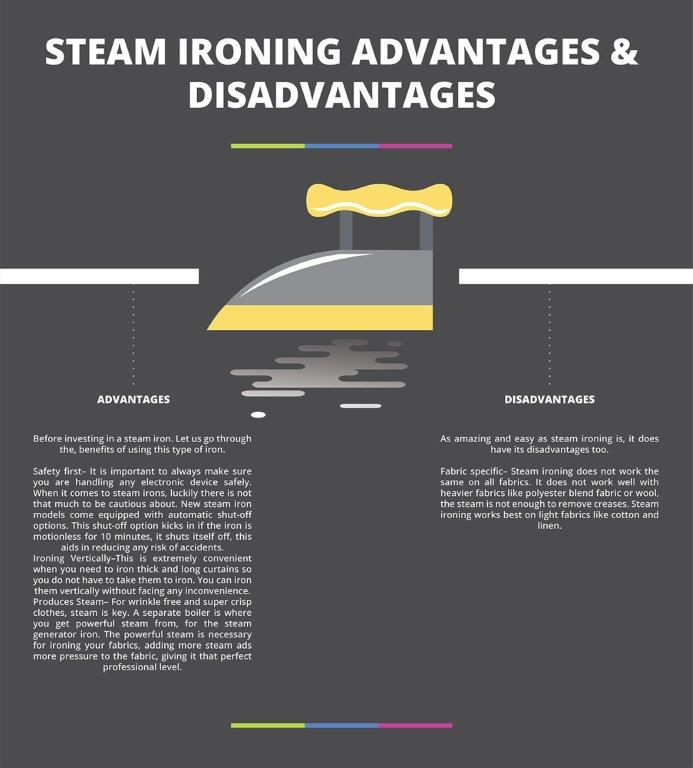
Steam Ironing- Advantages & Disadvantages


Ironing can be a daunting, time consuming and tiring task. Using a steam iron helps to give your garments the crisp and polished look and makes ironing faster than ever. Newer iron models use steam because steam gets the job done faster. Therefore, if you want to put in less effort and time in ironing, investing in a steam iron could be beneficial. However, there are pros and cons to everything including steam ironing. Below we go through the advantages and disadvantages of steam ironing.

Steam Ironing – Advantages

Before investing in a steam iron. Let us go through the, benefits of using this type of iron.

  • Safety first– It is important to always make sure you are handling any electronic device safely. When it comes to steam irons, luckily there is not that much to be cautious about. New steam iron models come equipped with automatic shut-off options. This shut-off option kicks in if the iron is motionless for 10 minutes, it shuts itself off, this aids in reducing any risk of accidents.
  • Ironing Vertically–This is extremely convenient when you need to iron thick and long curtains so you do not have to take them to iron. You can iron them vertically without facing any inconvenience.
  • Produces Steam– For wrinkle free and super crisp clothes, steam is key. A separate boiler is where you get powerful steam from, for the steam generator iron. The powerful steam is necessary for ironing your fabrics, adding more steam ads more pressure to the fabric, giving it that perfect professional level.

Steam Ironing- Disadvantage

As amazing and easy as steam ironing is, it does have its disadvantages too.

  • Fabric specific– Steam ironing does not work the same on all fabrics. It does not work well with heavier fabrics like polyester blend fabric or wool, the steam is not enough to remove creases. Steam ironing works best on light fabrics like cotton and linen.


  • Constantly Refilling Water– Refilling the iron run is very important because it can’t produce steam without the water. If the device has a small reservoir you need to refill it frequently. The solution is to keep a large storage of water near you when you start ironing.

These are just a few pros and cons of steam ironing. Though the advantages out way the disadvantages. The disadvantages can be taken care of with a few quick fixes. Visit Condrou Manufacturing for steam irons and other consumables.

Paper bags VS Non-woven bags

Paper bags VS Non-woven bags

With companies being more environmentally, more retail stores and businesses choose to use non-woven bags instead of nylon bags and traditional paper bags. Non-woven bags are made from non-woven fabric and are a type of reusable bag. The non-woven fabric is recyclable and eco-friendly. Below, we go through non-woven bags versus paper bags and which is the best for your business.


The first and most important difference of all, is that non-woven bags are reusable and paper bags are not. Paper bags on the other hand are often more expensive than the non-woven bags and can only be used by once. For promotional use paper bags aren’t very effective as they get thrown away. On the other hand, non-woven bags can be reused many times, making them more ideal for promotional purposes.

Next it is important to take note of the physical integrity of the bag that will be used and what it will be used for. If you will be packaging heavier product make sure you chose a more durable bag, that won’t break, tear, or stretch. Paper bags are more likely to tear because people overestimate the strength of these bags.

For banding and printing on either type of bag works because both of them can be printed on effectively. One key consideration is the volume of bags required. There is usually a minimum number of bags that can be printed.

The prices of paper bags and non-woven bags vary based on the dimensions of the bags and especially the type of material the bag is made from. In general paper bags tend to be more expensive than non-woven bags.

Finally, non-woven bags are eco-friendlier because they are a type of recycled bags that can decompose easily under the ground. Whereas paper bags are made from wood which means they have a negative impact on the environment. Therefor reducing the use of paper bags can save trees.

In conclusion, non-woven bags are more compatible than paper bags because they are recyclable, reusable and affordable. Condrou Manufacturing supplies branded and non-branded, non-woven bags. Place your order today.

The Key Concerns of Starting a New Hotel

The hotel industry, despite requiring significant effort and investment to get into, is a largely lucrative one. But setting up your own hotel to take advantage of its potential returns is no simple task. There is a great deal to think about, and missing a beat may lead to unnecessary expenses, delays or the complete failure of a project. Because of this, we are here to help you make sure you leave no stone unturned. So, if you are planning on opening a hotel, motel, guesthouse or resort, here are a few of the concerns you will need to think about first.

Choose the Right Location

Let’s go back for a second, to the year 2010. South Africa was hosting the Soccer World Cup and an influx of tourist were expected. As a result, guesthouses and hotels popped up everywhere in the hopes of making a future for themselves. It was a great opportunity, except that once the world cup was over, scores of these facilities (many of which were situated in residential areas with no real prospect for hospitality) had to close down. They were simply in the wrong location. So location is important. You need to make sure that you set up shop in an area frequented by tourists and holiday makers if you hope to stand a chance of success.

Be Prepared to Spend

The hospitality industry is a billion dollar industry, and while you are not expected to compete with the top players, you will need to be able to invest sever millions of Rand into the development of your facility. You’ll want to start gathering capital as soon as possible. If you cannot front the money yourself, you’ll need to get a loan from a financial institution. And for that, you will need proof of a well thought-out approach to your business; you’ll need a business plan.

Draw up a Business Plan

When starting any business, you will need a business plan first, and the hospitality industry is no exception to the rule. Your business plan needs to be simple but thorough, clear and persuasive. This way it will attract investors, and also outline the ideal approach for you to create a successful facility.

Focus on Improving Service Delivery

The hospitality industry is all about comfort and service, so if you want to build a good reputation and attract plenty of visitors, you will need to go above and beyond in this regard. That means you will need to source experienced, highly trained staff who are helpful, polite and obliging. It may be worth your while to offer training services to your current staff members to continue improving the services you offer.

You Need to Be Well Stocked

You will need to purchase and stock all manner of consumables, bathroom accessories, cleaning equipment, bedding and linen, laundry appliances, bin liners, coat-hangers and wracks and… well you get the point. To make this easier, you should partner up with a manufacturer that you can trust to consistently provide you with what you need, at a quality that you can trust, and at prices that will add value to the accommodation services you offer.

Contact Condrou Manufacturing for Details

For those who are looking to start the adventure of a hotel business, you will want a supplier that you can rely on. Contact Condrou Manufacturers, a hospitality consumables supplier in South Africa for information and pricing. Or visit our website today for further details.

Dry Cleaning Maintenance Tips

If you are running a dry-cleaning business, you likely have a whole host of things you need to take care of at once; and it can get remarkably overwhelming.

But just like any business that needs to work with specialised machinery, dry-cleaning businesses have a particular responsibility to their maintenance schedule.

Dry-cleaning machine maintenance is essential for keeping your equipment running; running equipment is the key to keeping business turning over, and ensuring that they are regularly maintained ensures that you won’t have to splash out your hard-earned cash on repairs and replacements that, quite frankly, could have been avoided.

Here we will go over a few details of dry-cleaning machine maintenance to ensure that you find it easy to stay on top of it.

To do this, we will touch on a few reasons why maintenance is important for these businesses and will take you through a number of essential dailies, weekly, monthly and annual maintenance tasks.

So, let’s get started:

Why Dry-Cleaning Machines Need Maintenance

Like any type of machinery, especially those that are used extensively on a daily basis, dry-cleaning machines also need regular maintenance. As you will see, some of these happen daily or weekly, while others are less frequent.

However, each of these tasks is essential for a number of reasons, so let’s take a look at why dry-cleaning maintenance matters to the extent that it does:

Mechanical Failures are Normal

In any setting where machines of any type are being used, there will, at some point or another, be a need for maintenance.

With any device that is mechanical by design, there are a number of moving parts that work with each other during operation.

Over time, as these parts move along each other, they create friction and slowly become worn down. If this gets left unchecked, the machine will eventually become inoperable.

Dry-cleaning machines are no different in this regard and need maintenance if they are to continue working optimally.

Aside from this, the various components that work in the dry-cleaning process like the lint bag and carbon absorbers will eventually become bogged down with debris from cleans. These need to be cleared as well as part of regular maintenance or the machine will begin to get ineffective.

Improve the Effectiveness of Cleaning

As a result of consistent maintenance, dry-cleaning machines will work as expected, which means that they will clean clothing more effectively, and with less effort applied.

This will ensure two things.

Firstly, your services will be far more consistent. When your clients drop off their laundry with you, they know that they will get perfect results, and you know that you will be able to fulfil those expectations.

The next thing it does is it allows for more efficient operations, which means that jobs will be completed in less time. This will, in turn, become a strong selling point for your clients, since they will get their clothes back, in perfect order, and in less time.

Damaged Dry-Cleaning Machines Cost More to Run

The next reason why you should be consistent with maintaining dry-cleaning machines is that they will become more cost-effective to run, in more than one way.

It is no secret that as machinery becomes worn down from use, that it tends to consume more power, resources and time to keep production running at an expected rate.

This is as true for machines in factories as it is for that specialised dry-cleaning suite that makes up the crux of your business.

Your dry-cleaning machine requires a lot of power, water and chemicals. So much so that around 50% of all of your business’s costs, come in the form of its utilities.

Neglect to maintain your machinery, and leaks and inefficiencies will start to raise that percentage substantially, which can cut into your profits substantially.

With regular maintenance, however, your machinery will be for more economical, meaning it will consume far fewer resources and will save your business both time and money as a result.

Avoiding a Need for Replacements

Replacement parts for just about any type of machinery is expensive, and it is an expense that often comes as unplanned; which can put undue stress on any type of business.

Things are no different when it comes to dry cleaning machines, in fact, the cost can be even more severe, due to the highly specialised nature of this machinery.

Of course, even with the best adherence to a maintenance schedule, some parts will eventually need replacing. But without regular maintenance, the need for replacement parts will certainly be more concentrated and will cost you more money.

Parts replacements are best done with original manufacturer parts (OEM), and when these parts are used, the cost of replacing them is that much higher.

When generic parts are used, you might stand to save a bit of money at the start, but there is a high chance that that part will need to be replaced before its time; which makes for an even more important reason why maintenance on dry cleaning machines needs to be done according to a strict schedule.

A Better Bottom Line for your Business

All of the above reasons why you should stay on top of maintenance amount to one major advantage for any dry-cleaning business, and that is a better bottom line; improved profitability.

The savings on time and money, as well as being able to impress and therefore retain your customers, all amount to a much more profitable dry-cleaning business for you.

Your dry-cleaning business is solely dependant on the machines that it uses, and when those machines break down, it often means that business stops dead in its tracks until the problem can be sorted out; which is exasperated if you are not prepared for such failures.

Regular maintenance won’t only ensure that gaps between replacements are lengthened, but will also give you a bit of an early warning when a component is about to fail so that you can plan accordingly and suffer less downtime; keeping the wheels of the business turning more consistently, and making you more money.

Daily Maintenance

With all of this out of the way, it is fairly easy to see why your dry-cleaning business needs to take maintenance seriously. To do this, you can divide maintenance tasks up into those that should happen daily, weekly, monthly, bi-annually and annually.

Let’s go over some of the daily tasks you need to take care of:


Button Trap Strainer & Lint Bag

In normal residential use, both the button trap strainer and the lint bag on washing and laundry machines need to be cleaned around once a month. In a dry-cleaning setting, where much higher quantities of clothes are cleaned in a day, this needs to be done on a daily basis.

Through use, both the button trap and lint bag will become bogged down with debris filtered from clothes during cleaning; whether this is because of excess lint and fluff, or even more solid objects like coins and buttons that have come out of pockets.

As these build up in the button trap and lint bag, they begin to make cleaning less effective. So if you have a particularly busy dry-cleaning service, you ought to at least have a look at these each day.

Water Separator

All dry-cleaners make use of water separators to remove water from dry-cleaning chemicals after a wash. The solvent is kept for later use after separation, while the now contaminated water is disposed of.

These also need to be given daily attention to ensure the clarity of the solvent being returned, if this is left undone, you will find yourself going through much larger quantities of the cleaning solvent, which will raise your expenses significantly.

Carbon Absorber

Carbon absorbers are used quite heavily in the dry-cleaning process to remove the organic compound from fabrics and the cleaning solvent during a wash. As you might expect, these compounds will remain on the carbon absorber, and eventually, start to bog it down.

You may be familiar with these from your home appliances, except that your home appliances don’t take on as much work as a dry-cleaning machine will.

As a result, dry-cleaners need to have carbon absorbers cleaned more often. For those that are particularly busy, it should be a daily task.

Distillation Unit

The distillation unit holds the cleaning solvent to be readied for being sent to the water separator, which is made up of a boiler and a condenser. This condenses the solvent to make it easier for it to be separated from the water.

This too needs to be cleaned on a regular basis to ensure that the solvent remains as pure as possible after separation, which means that potential contaminants in the distillation unit need to be removed, daily if necessary.

Weekly Maintenance

Checking for Leaks

Dry-cleaning machines are tough, but as we mentioned before, have a number of working parts that eventually result in wear and tear.

When this gets bad enough, many of the parts of your system will begin to leak. This is not only dangerous (since you are working with heat and chemicals), but will also result in higher costs since you will be going through far more water and solvent than you ought to.

Wash the Lint Bag

Even after clearing the lint bag on a daily basis, it will still become contaminated after a while.

Sure, it might not be bogged down with performance decreasing lint, but it will still be contaminated.

If left unchecked, this will lessen the cleaning quality of your machine, and may even produce odours after a clean.

Because of this, the actual lint bag should be laundered weekly.

Monthly Maintenance

Looking for Leaks: Diving Deeper

Even after your weekly check for leaks, you should have a closer look about once a month to ensure that everything is in order. This counts for both liquid leaks and vapour ones.

So, take some time out each month to inspect your exhaust damper, the ductwork in the lint trap and carbon absorber.

Dealing with Build-Up

Lots of build-ups will occur overtime as well, even with daily and weakly cleans of button traps and lint bags.

So, take some time each month to double-check that no lint and debris has built up over time. Pay particular attention to the temperature probe on the lint trap, the vent on the water separator, and on your condenser coils.

Every 6 Months: The Muck Cooker

The muck cooker is also an important part for distilling the solvent, except that this contraption allows it to be separated from muck produced from cleaning.

Just from this description of what it does, you can imagine how badly these components get bogged down after a while.

As a result, they need to be thoroughly cleaned to ensure that the distilled solvent remains pure. To do this effectively, you should clean the muck cooker at least twice a year.

Annual Maintenance: Coil Cleaning

Your condenser coils will also need a clean after extensive use, but it doesn’t need to happen as frequently as other types of maintenance; it should definitely be done at least annually, however.

Contact Condrou Manufacturers to Buy Dry Cleaning Machines

Is your dry-cleaning business on the lookout for a new, high-quality dry-cleaning machine? Contact a representative from Condrou Manufacturing today, or visit our website for additional details on our offers.

GET IN TOUCH